Open 24/7
contact@clinique-larose.com
Immeuble la Rose, av. de la Bourse, Les Jardins du Lac, Tunis 1053
Emergency +216 71 100 900

Menu
Pregnancy
Home › Mother and child › Pregnancy

Ultrasound
During the first three months of pregnancy, ultrasound and morphology scans will be performed by a team of qualified radiologists to monitor the good course of pregnancy.
Please note that for the smooth running of the ultrasound examination, it is strongly recommended to
No cream
Avoid the use of moisturizing cream or shower gel on your abdomen in the 5 days preceding the examination.
Empty stomach
Come on an empty stomach.
Filming
Ask for the doctor's permission if you want to film the examination.
Ultrasound appointment
If you need an ultrasound examination, do not hesitate to contact us:
Going further
Prenatal diagnosis is organized around a team made up of a prenatal diagnosis adviser, ultrasound doctors and (possibly) a psychologist. Screening or diagnostic ultrasounds are performed by a sonographer. All sonographers have a “1st trimester ultrasound” certification and are experts in prenatal diagnosis.
We also offer:
- The measurement of serum markers of the 1st or 2nd trimester, the results of which are subject to personalized monitoring.
- Diagnostic tests: amniocentesis for fetal karyotyping.
- Assessment of foetal DNA in maternal blood for patients at risk for Down Syndrome or wishing to carry out an assessment in the absence of any previous screening test.
- Trophoblast biopsies.
- Specialized consultations (genetic, surgical, etc.).
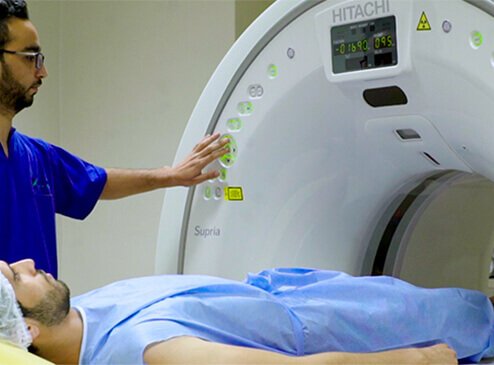
- Additional radiology exams.
Healthy food is of key importance for pregnant women. Indeed, a balanced diet will provide your body with all the elements necessary for its proper functioning and the healthy development of your baby. It is important to pay attention to your weight and avoid excessive weight gain. Note that the weight increase varies averagely between 9 and 12 kg (to ensure a safe and healthy pregnancy and birth). A nutritionist is available to advise and support you, if necessary.
In general, it would be better to:
- Not skip meals.
- Eat at least 3 meals a day and start the day with a good breakfast.
- Not “eat for two”.
- Vary your diet.
- Stay hydrated throughout the day (drink at least 1.5 l of water/day).
- Limit the consumption of juices and soft drinks.
- Eliminate all alcoholic beverages and tobacco.
Equipment — Maternity suitcase
We highly recommend that you remember to pack your suitcase in the 7th month of pregnancy. To help you prepare your suitcase and that of your newborn baby, we have found it useful to draw up the following indicative list:
For your newborn baby
- Bodysuits
- Pajamas
- One or two wool sweaters (even in summer)
- Socks or slippers
- A cap (even in summer)
- A sleeping bag
- A pillowcase
- A towel
- A pack of diapers
- Toilet soap
- Baby bottles
- The first cotton pack
And for the mother
- A water spray
- A nursing bra (if you are breastfeeding)
- Breast shells (if you are breastfeeding)
- Your personal belongings
- Sanitary napkins
- Toilet soap
Labor: D-Day
The signs of labor are:
- Regular and painful contractions (hardening of the abdomen for a few seconds, causing severe pain).
- Leaking amniotic fluid (water breaking).
- Bleeding.
In this case, go to the maternity ward without waiting. Once you arrive, you are welcomed by an on-call midwife, who will:
- Carry out an examination: she will measure your blood pressure and temperature, palpate your abdomen and perform a vaginal exam to check how dilated your cervix is.
- Monitor the baby’s heartbeat (measuring the fetal heart rate (FHR) and monitoring uterine contractions).
Looking for midwife advice ? Submit your questions and our consultants will provide you with the information you need !
Administrative procedures
To give birth at La Rose Clinic, you need to carry out the necessary administrative procedures at the admission office. What are the necessary documents ? You should bring:
- An official identity document with your photo.
- An admission letter (with the name and address of your attending physician).
- A support arrangement made with the insurance company.
- Your medical file (letters, x-rays, reports and lab tests).
- A consent form for surgery must be filled up, signed and returned upon arrival at the clinic. This consent form will be given to you by the medical secretary and will be kept in your stay file.
Modes of delivery
A natural childbirth is a birth in which there is no medical intervention. The body is allowed to do what it spontaneously knows how to do, helped by the midwife’s advice and your doctor’s recommendations. Some procedures are performed immediately upon arrival in the delivery room: taking hemodynamic constants and temperature, setting up an infusion and installing monitoring to make sure everything is going well.
Childbirth is like an adventure that is prepared in advance. We will support you in order to make it a moment of happiness. Childbirth preparation classes are provided for this purpose. Some women continue to give birth without an epidural. If the pain is too severe, an epidural can then be installed.
The epidural is intended to eliminate or reduce the pain of childbirth. Its principle is to block the transmission of painful sensations at the level of the nerves coming from the uterus by injecting a local anesthetic product nearby. This technique ensures good stability of vital functions, beneficial for the mother and the child.
If it is necessary to perform a caesarean section, the anesthesia may be supplemented by this device; this does not exclude the use of general anesthesia. Depending on your state of health or the result of additional examinations, it may happen that epidural analgesia cannot be performed. The final choice and the performance of the procedure are the decision of the anesthetist-intensivist and the choice of the patient.
The caesarean section is a surgical procedure, which can be scheduled or decided in an emergency at the time of delivery. Nowadays, it is estimated that about two women out of five have a caesarean section. Even when the delivery was planned naturally, the caesarean section may be performed during labor in certain cases (e.g. when the baby is suffering, the non-progression of the opening of the cervix, etc.).
Under anesthesia, the obstetrician makes a horizontal incision, between 9 and 10 centimeters, of the abdomen at the level of the pubis. He then separates the muscular layers to reach the uterus and extract the baby. The duration of your stay in the clinic depends on the mode of delivery (vaginal delivery, caesarean section) and the postpartum period. It varies from 2 to 3 days.
After birth
At birth, you can enjoy a moment of discovery of your newborn, their skin against yours. This privileged moment, better known as “skin to skin” or the “kangaroo method”, has many benefits, in particular: reassuring the baby and helping them sleep better, developing their immune system, facilitating breastfeeding, and strengthening the bonds of attachment.
How to take care of the baby ?
Products to plan for your return home:
- Diapers.
- Saline solution.
- Cotton.
- Hypoallergenic liquid soap.
- Sterile dressings.
- Eosin for umbilical cord care (discharge prescription).
- Diaper rash cream.
Prepare:
- A towel and clothes.
- A diaper.
- Bath soap.
- Face and cord care products.
Then prepare the bathroom and run the water before you start undressing your baby:
- The room temperature should be around 23°C.
- The water temperature should be 37° (the use of a bath thermometer is recommended).
Once in the bath water:
- Put baby shampoo on their head.
- Gently rub the scalp then the neck, armpits and buttocks, going from top to bottom.
- Rinse them off.
- Wash your hands or use a hydroalcoholic solution.
- Clean the umbilical cord base daily after the bath, using a saline-moistened dressing.
Eyes: Clean your child’s eyes with the saline solution and then wipe each eye with a serum-moistened dressing from the inner corner to the outer corner of the eye. Eye drops may be prescribed by your doctor.
Ears: When you are drying your baby’s skin after the bath, clean their ears with a towel, or with a “special infant” cotton swab with a large tip.
Nose: During your stay in the maternity ward, the nursing assistants taught you how to clean your child’s nose with saline solution. It is important for you and your child to know how to perform this procedure in case of nasal congestion because your child cannot yet breathe through their mouth. When you get home, this treatment is only necessary in case of nasal congestion.
The room: The ambient room temperature should be between 22 and 24°C. Avoid putting the crib next to the heater. Air out your baby’s room on a daily basis no matter the season. It is strongly recommended to avoid smoking in the house and especially in your baby’s room.
The crib: The mattress must be firm and adapted to the crib dimensions. It is advisable to avoid pillows, blankets and duvets (at least up to 2 years). It is strongly recommended to favor the use of sleeping bags or nests.
Sleeping positions: Place your baby on their back, with their head slightly turned to the side and their nose clear to facilitate breathing. Remember to alternately turn their head to avoid the flat head syndrome. Avoid falling asleep with them in your bed. It is not recommended to leave cuddly toys in your child’s crib.
Looking for Pediatric Nurse advice ? Submit your questions and our consultants will provide you with the information you need !
The baby food
Breastfeeding is particularly suitable for your child. For a first baby, you can prepare the nipples by massaging them every day with an unscented cream. Breastfeeding must be considered and decided before birth. The nursing teams are there to advise and support you. Ideally the baby should be breastfed in the delivery room within two hours of birth.
In the first few days, the rhythm of feedings will be irregular. It is important to note that the more often your baby is breastfed, the faster and easier the milk will come in. You must be available to your baby and adapt to their rhythm.
Some mothers choose the bottle. They should not feel guilty. Each mother must find the solution she prefers or the most suitable. The equipment needed for the return home:
- Four classic shape and easy-to-clean glass bottles of 240 ml.
- Four 6-12 month pacifiers. It is advisable that you get silicone pacifiers because they are sturdy.
- 1 cleaning brush.
- 1 powdered-milk tin (you can ask for advice from the maternity staff or the pediatrician).
- Bottled mineral water.
It is recommended to sterilize bottles, rings and pacifiers before first use.
SIMILAR SERVICES
La Rose Clinic offers a selection of similar services to meet your needs.
Medical imaging

Neonatalogy

Obstetric gynecology

MAP — Fertillia